
Creative Journal · Founding idea
Pass on what must not disappear.
John Legacy was not born from a desire to occupy centre stage. It began with a conviction: some stories must not remain in silence.
5 August 2026 · John Legacy
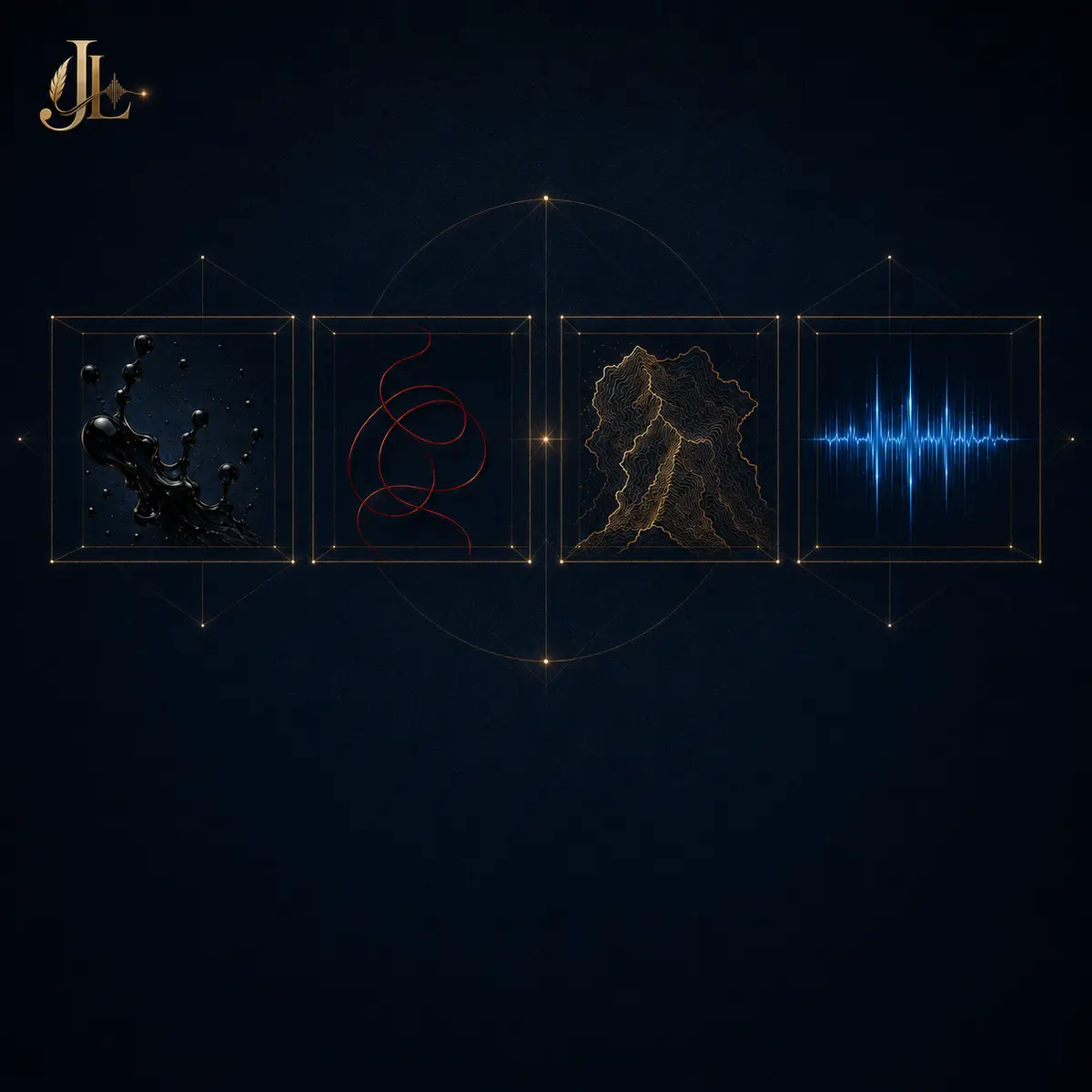
What matters most is not who I am, but what I hope to pass on.
An intention before it became a name
John Legacy is less a character than an intention: to write stories, preserve traces and create spaces where artists can give those stories a voice, music, a face or movement.
I have never thought of myself as the performer at the centre of the stage. My role lies elsewhere: in the writing, in the construction of a narrative and in the meeting of different sensibilities.
A song may begin with a few words. It may then meet a performer’s voice, a filmmaker’s eye, a dancer’s gesture or an illustrator’s world. Each person brings a part of the truth that the writer could not create alone.
John Legacy finds its purpose in this movement between art forms and between people.
What Legacy means
The word legacy means what is passed down.
But a legacy is not only what we receive. It is also what we choose to preserve, transform and pass on.
We inherit stories told in lowered voices, incomplete memories, gestures observed in childhood and silences whose meaning we may only understand much later. Some of these traces remain within family memory. Others risk disappearing with the people who carry them.
Creating then becomes a way of holding on to what is fading without fixing it in place.
The aim is not to reconstruct the past as a monument or to claim that everything can be explained. It is to listen to what remains, respect its areas of shadow and offer it a form capable of travelling beyond the family circle.
Receive, listen, transform and pass on.
The story from which all the others began
The story of my mother, Jeannine, holds a founding place in this approach.
Her life could not be reduced to the wounds she carried. It also contained a childhood, hopes, contradictions, choices, moments of joy and a strength that had long remained silent.
Through Le silence avait quarante ans — Forty Years of Silence, I wanted to preserve that complexity. Not to speak in her place, but to try to listen with enough attention and restraint.
This intimate story gradually found several forms: a novel, songs, images and a narrative album in French, English and Reunion Creole.
Each form reveals a different dimension. The novel can hold duration and nuance. A song can sometimes reach an emotion that explanation cannot convey. An image opens a space into which each person can project their own memory.
The purpose is not to expose a private life. It is to transform a singular experience into a work of memory, resilience and legacy.
Reunion Island as a way of seeing the world
Reunion Island is not a setting added to John Legacy’s projects.
It is present in the landscapes, languages, silences and ways of resisting. It lives in the rain, the paths, the water, the hands, the voices and the memories passed from one generation to the next.
This grounding is not intended to produce a folkloric image of the island. It is a point of departure.
A story deeply rooted in Reunion can resonate with experiences lived elsewhere. The more faithfully it remains connected to its place and singularity, the more it can open a path towards the universal.
The intention is therefore not to speak on behalf of Reunion, but to create from within it, with all that it has left in memory and sensibility.
Not standing alone in the light
John Legacy is also built on a simple idea: a work may belong to one vision without being carried by one person alone.
The texts are written to meet performers, composers, musicians, filmmakers, dancers, illustrators and other creators. Collaboration does not arrive at the end of the process. It is part of the work itself.
Each artist is invited to bring their own sensibility without erasing the original story. A voice does more than perform a song. It gives it breath, fragility and human presence.
For this reason, John Legacy is not conceived as a succession of isolated tracks. Every song opens the door to a wider narrative world.
The Shadow of Love, Paul & Virginie, Ô Bourbon! and We Run, We Run, We Run! are the first signs of four projects intended to develop over time. Each has its own memory, visual language and emotional material.
Creating a home for stories
John Legacy aspires to become a digital home where literature, music and image can meet.
A place to discover completed works, but also the stages of their creation, their uncertainties, their encounters and the decisions that shape them.
This Journal was created to make that journey visible.
It will not tell only of releases and results. It will also make room for the quiet work: a sentence that resists, a voice still being sought, an arrangement revised or an image that changes the way a song is perceived.
The founding idea behind John Legacy can ultimately be expressed in a few words: receive, listen, transform and pass on.
Create so that certain stories do not disappear.
Create so that they can meet other voices.
Create, finally, so that what begins in one person’s memory can become a shared emotion.
The dragonfly moves through the John Legacy world as a sign of breath, movement and freedom.
The Journal continues
Follow the works as they come into being.
Discover the choices, encounters and stages that gradually give form to each John Legacy project.
Back to the Journal